Showing posts with label death penalty. Show all posts

Sunday, February 14, 2016

Man freed after 28 years; witness claimed his face appeared in a dream

Moses-EL was convicted after the victim identified him, saying his face came to her in a dream. So prosecutors ignored the convicted rapist she had originally named.  

Prosecutors in Denver, Colorado are still considering trying Moses-EL again for the rape.


Man Held Decades in Colorado for Rape He Denies WalksFree
Dec 22 2015
by The Associated Press

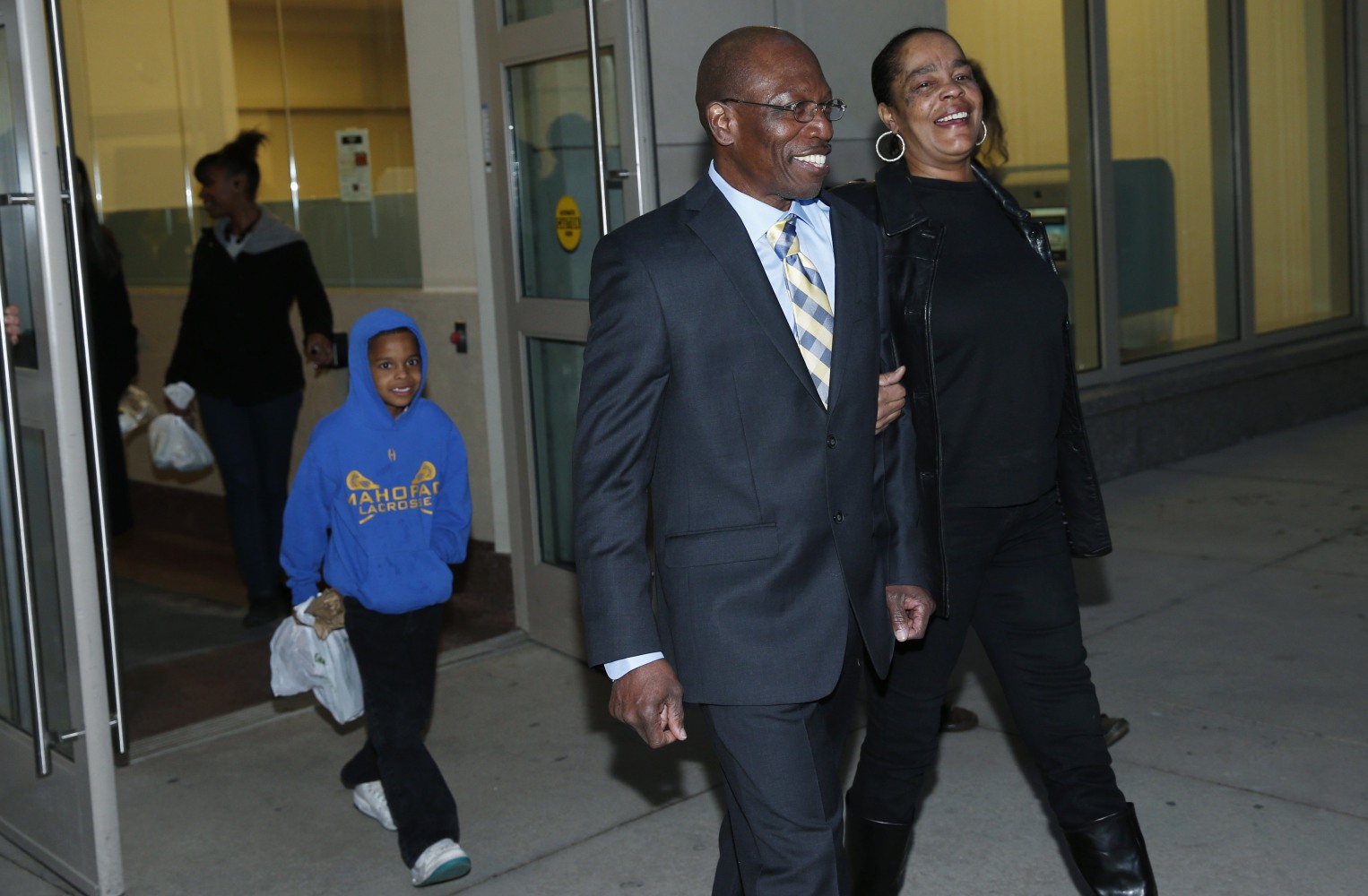
A Denver man who spent more than a quarter-century in prison for an attack he denies committing walked free Tuesday, locking arms with his wife as his tearful children applauded and his grandkids embraced a man they had never met. 

Clarence Moses-EL, 60, had just posted a $50,000 bond that a judge required for his freedom after she overturned his 1988 conviction on rape and assault charges and found that he would likely be acquitted if his case went to trial again. Moses-EL was convicted after the victim identified him, saying his face came to her in a dream. 


When police initially asked her who assaulted her, she named another man, who later confessed to having sex with her at the same time that night. 

Man's Rape Conviction Overturned After 28 Years 

Outside the jail Tuesday, Moses-EL wore a black suit and tie as he stood beside his wife, Stephanie Burke, moments after hugging three of his 12 grandchildren for the first time. 

Surrounded by his tearful children, he took a deep breath of the crisp late afternoon air.
"This is the moment of my life, right here," Moses-EL told reporters. "I'm at a loss for words. I just want to get home to my family."

Moses-EL has long maintained his innocence, and his case inspired legislation requiring preservation of DNA evidence in major felony cases for a defendant's lifetime after police threw out body swabs and the victim's clothing. Supporters posted bond for his release after Moses-EL was transferred from the prison where he was housed for decades..

His spirituality kept him from losing hope during 28 years of his 48-year sentence, he said.
"And my innocence," he said. "That's what really kept me going." 

But still looming was the prospect of a new trial. Prosecutors have not decided whether to try Moses-EL again, saying they are considering the age of the case and the availability of witnesses. A tentative trial date was set for May, if prosecutors decide to pursue new charges. 

The case involved a woman who was attacked after she returned home from a night of drinking. When police initially asked who assaulted her, she named the man who later confessed to having sex with her. 

More than a day after the assault, while in the hospital, the woman identified Moses-EL as her attacker, saying his face appeared to her in a dream. 

Moses-EL's efforts to appeal his conviction were unsuccessful and the legal and political system repeatedly failed him in his decades-long attempt to win his freedom. 

He won a legal bid for DNA testing on the evidence to clear his name, but Denver police threw it away, saying they didn't see any notice from prosecutors to hold on to it. 

In 2008, the governor, a former Denver prosecutor, objected to legislation that would have given him a new trial and that received widespread support from lawmakers. 

Moses-EL's break came when L.C. Jackson, whom the victim had initially identified as her rapist, wrote to Moses-EL in 2013 saying he had sex with the woman that night. Jackson has not been charged in this case but is imprisoned for two other rapes in 1992. 

His attorney, Eric Klein, said it would be foolish for prosecutors not to dismiss the case against an innocent man…

Sunday, September 7, 2014

Prosecutor Joe Freeman Britt, no longer admired for record-breaking number of Death Row convictions

As 2 Go Free, a Dogged Ex-Prosecutor Digs In


LUMBERTON, N.C. — The most memorable moment of the trial that put Henry McCollum and Leon Brown behind bars for three decades for a hideous 1983 rape and murder was a display of brilliant courtroom theatrics.

District Attorney Joe Freeman Britt of Robeson County, who stood 6-foot-6 and came to be known as America’s “Deadliest D.A.,” asked jurors to try to hold their breath for five minutes — the time it took the 11-year-old victim to choke to death, after her killer stuffed her panties down her throat with a stick — to get a small sense of the horror she experienced.

The jury came back with two of the more than 40 death penalty convictions Mr. Britt won over almost two decades.


Those two convictions — obtained on the basis of inconsistent, soon recanted, confessions from two mentally impaired teenagers who said they had been coerced to sign statements written by interrogators, and testimony from an informer who previously did not implicate the two young men — were overturned last week. Mr. McCollum and Mr. Brown were exonerated and set free.


Photo

Leon Brown in his death row cell block in 1987. Credit Scott Sharpe/The News & Observer, via Associated Press

Their release concluded a judicial horror story in which the two men were sent to death row though no physical evidence linked them to the murder, while a serial sex offender who lived less than 100 yards from the crime scene — and who, a few weeks after that murder, would kill a teenage girl nearby in strikingly similar circumstances — was never pursued as a suspect.

But if the case was finally closed, the episode reopened ugly memories of what critics say was a merciless criminal justice system that ran roughshod over helpless people for decades in this poor, sprawling, racially volatile county sometime known as the Great State of Robeson.
At the heart of that is the legacy of Joe Freeman Britt, who earned a spot in “Guinness World Records” and a “60 Minutes” profile for his prowess in sending people to death row. (Only two were eventually executed. The most infamous was Velma Barfield, 52, who died from lethal injection in 1984 for killing her fiancĂ© by poisoning his beer.)

And whereas Mr. Britt, now 79 and retired, once dominated this county and won headlines for convictions, now some on both sides of the courtroom see a different tale.

The current district attorney, Johnson Britt, whose grandfather was first cousin to Joe Freeman Britt’s father, suggested that his predecessor could be tyrannical.

“He is a bully, and that’s the way he ran this office,” he said. “People were afraid of him. Lawyers were afraid of him. They were intimidated by his tactics. And he didn’t mind doing it that way.” He added: “You treat people with dignity, and you can get a whole lot more done that way than you can by trying to run over people. And that’s part of his legacy, that he ran over people.”
In a subsequent interview, Joe Freeman Britt made it clear that Johnson Britt was not his kind of prosecutor, either.

“Well, let’s say, if I was a bully, he is a pussy. How about that?” the elder Mr. Britt said...

Read more.

Saturday, August 9, 2014

Fresh doubts over a Texas execution; New evidence revives concerns that a man was wrongly put to death in 2004


New evidence revives concerns that a man was wrongly put to death in 2004
Published on August 3, 2014
 
CORSICANA, Tex. — For more than 20 years, the prosecutor who convicted Cameron Todd Willingham of murdering his three young daughters has insisted that the authorities made no deals to secure the testimony of the jailhouse informer who told jurors that Willingham confessed the crime to him.

About this project: The investigation was reported and written by Maurice Possley for The Marshall Project, a new nonprofit news organization focused on the criminal justice system. Sign up for updates on their launch.

Since Willingham was executed in 2004, officials have continued to defend the account of the informer, Johnny E. Webb, even as a series of scientific experts have discredited the forensic evidence that Willingham might have deliberately set the house fire in which his toddlers were killed.
But now new evidence has revived questions about Willingham’s guilt: In taped interviews, Webb, who has previously both recanted and affirmed his testimony, gives his first detailed account of how he lied on the witness stand in return for efforts by the former prosecutor, John H. Jackson, to reduce Webb’s prison sentence for robbery and to arrange thousands of dollars in support from a wealthy Corsicana rancher. Newly uncovered letters and court files show that Jackson worked diligently to intercede for Webb after his testimony and to coordinate with the rancher, Charles S. Pearce Jr., to keep the mercurial informer in line...

Friday, September 16, 2011

Justice Stevens Extols Pro Bono Service, Criticizes Connick Ruling

September 15, 2011
Justice Stevens Extols Pro Bono Service, Criticizes Connick Ruling
Blog of Legal Times

Retired Supreme Court Justice John Paul Stevens said Thursday night that for lawyers, "the greatest reward is not monetary," as he urged attorneys to take on clients in need of help on a pro bono basis.

Stevens, 91, spoke and received an award at a Washington celebration of the 25th anniversary of the American Bar Association Death Penalty Representation Project, which recruits volunteers from top law firms to assist death row inmates in their appeals.

Project director Robin Maher told the audience that the hundreds of lawyers recruited over the years have helped move 50 inmates off death row, either through exoneration or reduced sentences. She said the need is still great for lawyers to give skilled representation to those on death row, many of whom have had woefully inadequate counsel at trial and during the appeal process. "We need a much stronger word than crisis" to describe the situation, she said. The project trains and supports lawyers who participate.

Three law firms -- Arnold & Porter, Dorsey & Whitney, and Fredrikson & Byron -- received awards at the event for their pro bono representation. Also speaking was Anthony Graves, who was freed from prison in Texas last October after 12 years on death row and six years in prison. A special prosecutor appointed to review his conviction found no credible evidence linking Graves to the murders he was charged with committing.

"I was naive," Graves told the audience at the Decatur House, near the White House. "I thought if I was innocent, I would come out victorious." But the process of vindication took 18 years.

In his remarks, Stevens said that during his private practice years roughly 50 years ago, he never represented someone on death row. But he did take on the case of a prisoner at Joliet Correctional Center in Illinois who claimed that he had confessed to his crime because the police had beaten him. "I was convinced his story was true," Stevens said. Stevens remembers the case vividly, which he said is proof of how meaningful and rewarding pro bono service is.

Stevens, who in 1976 voted to reinstate capital punishment, announced in a 2008 decision that he had come to view the death penalty as unconstitutional, in part because of the risk of executing innocent people. He retired in June, 2010.

Stevens made it clear in his talk that he is still upset about the Supreme Court's March 29 decision in Connick v. Thompson. Stevens sharply criticized the ruling in a speech in May, and it is still on his mind.

In spite of extensive evidence of prosecutorial misconduct in New Orleans, a majority in Connick struck down a damages judgment that had been awarded to freed death row inmate John Thompson. That outcome turned on the Court's finding that the prosecutor could not be held liable for failure to train his staff, based on a single violation of Brady v. Maryland -- withholding exculpatory evidence from the defense. In his majority opinion, Justice Clarence Thomas cited the 1978 Monell decision, which said local governments could be held liable for civil rights violations only for actions that were based on official municipal policy.

Last night Stevens said the need to establish that a municipal policy such as inadequate training led to the civil rights violation was an "off the wall" and "obviously unwise" standard that "causes so much work" and should be changed. The common law concept of respondeat superior, which holds the supervisor responsible for the torts of employees, is the way to go, in Stevens' view...

Troy Davis in spotlight again as execution nears

September 16, 2011
Troy Davis in spotlight again as execution nears
Edecio Martinez

(CBS/AP) ATLANTA - Hundreds of thousands of people are rallying to support Georgia death row inmate Troy Davis. They not only oppose capital punishment but they also believe the state could put an innocent man to death.

The case is packed with drama: the murder of an off-duty police officer; conflicting eyewitness testimony; last-minute court decisions sparing a condemned man's life and global dignitaries who say they fear an innocent man could die.

Davis' case has captured considerable attention because of the doubt raised over whether he killed Mark MacPhail in Savannah in 1989. The U.S. Supreme Court even granted Davis a hearing to prove his innocence. It was the first time it had done so for a death row inmate in at least 50 years but he couldn't convince a judge to grant him a new trial.

The officer's family believes there is no doubt that Davis killed MacPhail and prosecutors say the right man was convicted.

Davis is scheduled to die Wednesday which is the fourth time his execution has been set in four years. He once came within two hours of being put to death. His attorneys say his legal appeals are exhausted and the chances of him winning another reprieve have dwindled.

However, supporters hope to convince Georgia's pardons board next week to spare his life.

The execution of Davis "risks taking the life of an innocent man and would be a grave miscarriage of justice," said former President Jimmy Carter, a Democrat from Georgia and death penalty opponent who wrote a letter on Davis' behalf.

Sunday, September 7, 2008

Did a judge-prosecutor romance taint Texas murder trial?

I don't think the outcome of this case would necessarily have been different if the judge had recused herself. But I do think she was wrong not to recuse herself.

Defendant faces execution Sept. 10
By Warren Richey
The Christian Science Monitor
September 8, 2008 edition

...The lawyer for a death-row inmate says he is trying to break a "conspiracy of silence" in Texas over whether the district attorney and the judge who presided over his client's 1990 capital murder trial were having a secret romantic relationship.

The inmate, Charles Dean Hood, is scheduled to be executed on Wednesday.

A Texas judge has ordered a hearing into the issue on Monday morning. The judge has also ordered the former judge and former district attorney to be prepared to answer questions under oath about their alleged affair and potentially surrender any documentary evidence of a relationship.

The unusual twists and turns in the Hood case are attracting national attention and adding fuel to an already-heated debate over capital punishment in Texas...