Showing posts with label Overeager prosecutors. Show all posts

Sunday, February 14, 2016

Man freed after 28 years; witness claimed his face appeared in a dream

Moses-EL was convicted after the victim identified him, saying his face came to her in a dream. So prosecutors ignored the convicted rapist she had originally named.  

Prosecutors in Denver, Colorado are still considering trying Moses-EL again for the rape.


Man Held Decades in Colorado for Rape He Denies WalksFree
Dec 22 2015
by The Associated Press

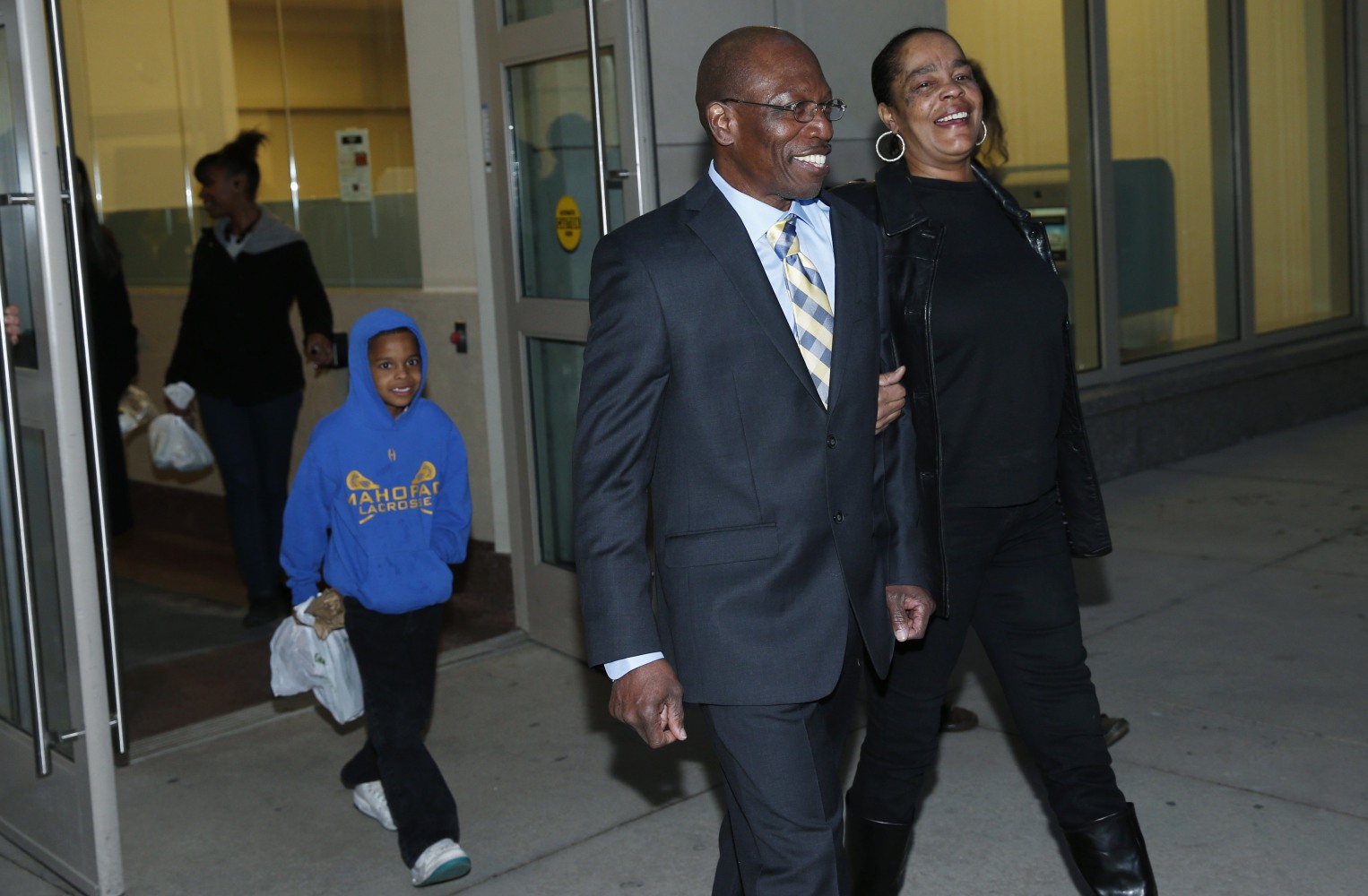
A Denver man who spent more than a quarter-century in prison for an attack he denies committing walked free Tuesday, locking arms with his wife as his tearful children applauded and his grandkids embraced a man they had never met. 

Clarence Moses-EL, 60, had just posted a $50,000 bond that a judge required for his freedom after she overturned his 1988 conviction on rape and assault charges and found that he would likely be acquitted if his case went to trial again. Moses-EL was convicted after the victim identified him, saying his face came to her in a dream. 


When police initially asked her who assaulted her, she named another man, who later confessed to having sex with her at the same time that night. 

Man's Rape Conviction Overturned After 28 Years 

Outside the jail Tuesday, Moses-EL wore a black suit and tie as he stood beside his wife, Stephanie Burke, moments after hugging three of his 12 grandchildren for the first time. 

Surrounded by his tearful children, he took a deep breath of the crisp late afternoon air.
"This is the moment of my life, right here," Moses-EL told reporters. "I'm at a loss for words. I just want to get home to my family."

Moses-EL has long maintained his innocence, and his case inspired legislation requiring preservation of DNA evidence in major felony cases for a defendant's lifetime after police threw out body swabs and the victim's clothing. Supporters posted bond for his release after Moses-EL was transferred from the prison where he was housed for decades..

His spirituality kept him from losing hope during 28 years of his 48-year sentence, he said.
"And my innocence," he said. "That's what really kept me going." 

But still looming was the prospect of a new trial. Prosecutors have not decided whether to try Moses-EL again, saying they are considering the age of the case and the availability of witnesses. A tentative trial date was set for May, if prosecutors decide to pursue new charges. 

The case involved a woman who was attacked after she returned home from a night of drinking. When police initially asked who assaulted her, she named the man who later confessed to having sex with her. 

More than a day after the assault, while in the hospital, the woman identified Moses-EL as her attacker, saying his face appeared to her in a dream. 

Moses-EL's efforts to appeal his conviction were unsuccessful and the legal and political system repeatedly failed him in his decades-long attempt to win his freedom. 

He won a legal bid for DNA testing on the evidence to clear his name, but Denver police threw it away, saying they didn't see any notice from prosecutors to hold on to it. 

In 2008, the governor, a former Denver prosecutor, objected to legislation that would have given him a new trial and that received widespread support from lawmakers. 

Moses-EL's break came when L.C. Jackson, whom the victim had initially identified as her rapist, wrote to Moses-EL in 2013 saying he had sex with the woman that night. Jackson has not been charged in this case but is imprisoned for two other rapes in 1992. 

His attorney, Eric Klein, said it would be foolish for prosecutors not to dismiss the case against an innocent man…

Tuesday, November 25, 2014

The officer asked Chris Craig for his gun and Chris' friend advised, "Let him have it."


Overeager prosecutor's  managed to get Derek Bentley hanged for murder.  He has since been pardoned.
 
 
Before Doctor Who, Chris Eccleston played a man facing an odd murder rap


Let Him Have It (1991)

Many criminal cases over the years have turned on fine points of evidence, but the 1952 prosecution of Derek Bentley for the murder of Police Constable Sidney Miles may be the only instance in which life or death came down to a question of grammatical ambiguity.

The facts were uncontested: Bentley, who’d participated in a burglary with his friend Christopher Craig, was already in police custody when the fatal shot was fired—by Craig.

During the standoff, however, as the police ordered Craig to surrender his gun, Bentley yelled “Let him have it, Chris!”

Craig subsequently shot one policeman in the shoulder and another, Miles, in the head, killing him instantly. As a juvenile (age 16), Craig couldn’t receive the death penalty, but Bentley, who was 19, could.

 Prosecutors argued that “Let him have it!” meant “Open fire!” and that Bentley, by egging Craig on, was just as responsible for the murder as if he’d pulled the trigger himself.

The defense, on the other hand, maintained that Bentley, whose I.Q. was estimated at 77 (“borderline feeble-minded,” in the parlance of the era), was merely instructing Craig to give the gun to the officer who was requesting it. Convicted of murder, Bentley was hanged to death on January 28, 1953.

Peter Medak’s 1991 drama Let Him Have It, starring Chris Eccleston as Bentley and Paul Reynolds as Craig, openly sympathizes with the now-prevailing view that Bentley was railroaded. (Two years earlier, Elvis Costello had revived interest in the case via the song “Let Him Dangle,” which opens with the lines “Bentley said to Craig / ‘Let him have it, Chris!’ / They still don’t know today just what he meant by this.”) Medak, whose most celebrated films include The Ruling Class (1972) and Romeo Is Bleeding (1993), had previously made another, much more violent true-crime saga, The Krays (1990), which tells the story of England’s most notorious gangsters (immortalized by Monty Python as the Piranha Brothers, Doug and Dinsdale). Let Him Have It, by stark contrast, finds Medak in a despairing mood, depicting a tragedy that begins long before a jury chooses to assign an improbably malevolent interpretation to Bentley’s fateful words. Even Craig, the ostensible criminal mastermind and actual gunman, is essentially just playing at cops and robbers as a means of escape from intolerably dismal living conditions. Bentley was posthumously pardoned by the Crown in 1998, but while Let Him Have It no longer has an urgent mission, it’s an agonizingly sober film, still capable of inspiring righteous outrage on behalf of squandered lives.
Availability: Let Him Have It is available on DVD, which can be obtained from Netflix or your local video store/library, or to rent or purchase from the standard digital services.

Saturday, November 22, 2014

Ohio Men Wrongly Convicted of Murder After 39 Years Released


Two Ohio men wrongly accused of murder experienced freedom for the first time in nearly four decades on Friday morning, but said they don’t harbor bitterness over their unjust imprisonment.
A Cleveland judge on Wednesday had dropped all charges against Ricky Jackson, 57, and Wiley Bridgeman, 60, allowing for the pair’s release. 

Jackson was 19 when he was convicted along with Bridgeman and Bridgeman’s brother, Ronnie, in the 1975 shooting death and robbery of Harold Franks, a Cleveland-area money order salesman. 

Testimony from a 12-year-old witness helped point to Jackson as the triggerman and led a jury to convict all three. Ronnie Bridgeman, now known as Kwame Ajamu, was paroled from prison in 2003. 

The witness, Edward Vernon, now 53, recanted his testimony last year, saying he was coerced by detectives, according to Cuyahoga County court documents. Vernon wrote in a 2013 affidavit that he never saw the murder take place, but he was told by detectives that if he didn’t testify against Jackson, his parents would be arrested.
Vernon said he confided in a pastor several years after meeting with Bridgeman, and the pastor encouraged him to reach out to the Innocence Project. Vernon wrote that he had “been waiting to tell the truth about this for a long time.”
“A lot of people think I should be mad,” said Jackson, but “in ’75, he was a 12-year-old-kid.” Jackson said “it took a lot of courage” for the witness to recant his statement.
The Ohio Innocence Project, which took up the case, said Jackson had been the longest-held U.S. prisoner to be exonerated. 
Jackson was originally sentenced to death, but that sentence was vacated because of a paperwork error. The Bridgeman brothers remained on death row until Ohio declared the death penalty unconstitutional in 1978.
“One of them came within 20 days of execution before Ohio ruled the death penalty unconstitutional” said Mark Godsey, director of the Ohio Innocence Project.
“The bitterness is over with,” said Wylie Bridgeman during his first moments of freedom on Friday.
Jackson agreed. “I had plans for my life,” but “time is just something that you can't get back so I'm not going to really cry about it,” he said.
While Ohio provides compensation for those who are wrongfully imprisoned, everyone is not guaranteed money. The Ohio Innocence Project has set up a fund for Jackson.
A story published in Scene Magazine in 2011 first raised new questions about the murder and whether Jackson and the Bridgeman brothers actually committed the crime.
Cuyahoga County Prosecutor Timothy McGinty said in court Tuesday that without an eyewitness there was not much of a case. “The state is conceding the obvious," he said, according to Reuters.
NBC News' Emmanuelle Saliba contributed to this report. Reuters also contributed.
byline photo

Cynthia McFadden

Cynthia McFadden is the senior legal and investigative correspondent for NBC News. Before joining NBC... Expand Bio

Longest Wrongful Incarceration in California History – First of the California 12 To Be Released

Michael Hanline’s Conviction Reversed – Release Expected Monday
Michael Hanline and his wife before wrongful conviction
Michael Hanline and wife Sandee – 1974
California Innocence Project Client’s Conviction Reversed After 36 Years
Longest Wrongful Incarceration in California History – First of the California 12 To Be Released
Ventura, November 18, 2014 – A judge has overturned the conviction of Michael Hanline, convicted of a murder that was committed in 1978, after lawyers from the California Innocence Projectand the Ventura County District Attorney’s Office agreed that documents were withheld from Hanline at his original trial showing that others may have been responsible for the crime.
Additionally, new DNA evidence pointing to Hanline’s innocence undermined the District Attorney’s confidence in the conviction.
At 36 years, this ends the longest wrongful incarceration in
California history.
Hanline was wrongfully convicted of the shooting death of
victim J.T. McGarry in 1980. At the time, prosecutors argued Hanline was jealous of McGarry because the two were romantically involved with the same woman, and that Hanline and an accomplice killed McGarry in revenge. Hanline has always claimed others were responsible for the murder, and that he had been wrongfully accused.
The California Innocence Project began looking into Hanline’s case in 1999, the year the project was founded, and fought for years to obtain evidence from the 1978 murder. Finally, in 2008 a federal magistrate ruled that his conviction should be overturned. Unfortunately, another federal judge overruled the reversal. Hanline’s case seemed to be over, and his only other option appeared to be the granting of clemency from the Governor. His case was one of the California 12—twelve cases where innocence clemency petitions were presented to Governor Brown 18 months ago after a 712 mile Innocence March from San Diego to Sacramento by lawyers from the California Innocence Project.
“DNA testing recently conducted shows that another individual committed this crime and proves Mike’s innocence,” said Justin Brooks, Director of the California Innocence Project at California Western School of Law and one of the lawyers who walked 712 miles in the Innocence March. “It’s amazing that Mike will finally be released after 36 years of wrongful incarceration. It’s time for him to get back to his family and his life.”
“I’m so pleased that the Ventura County District Attorney’s Office agreed to examine the case and join us in the petition to reverse the conviction,” said Alex Simpson, Associate Director of the California Innocence Project at California Western School of Law and the attorney who argued the petition. “This is how cases should be resolved.”
Hanline will appear before Judge Donald Coleman of the Ventura County Superior Court on November 24 where he is expected to be released.
About the California Innocence Project
The California Innocence Project is a California Western School of Law clinical program dedicated to the release of wrongfully convicted inmates and providing an outstanding educational experience for students enrolled in the clinic. The California Innocence Project receives approximately 2,000 claims from inmates each year and has earned the exoneration of 11 wrongfully convicted clients since its inception.

Friday, October 10, 2014

Los Angeles woman freed after spending 17 years in prison for murder she didn't commit


Los Angeles woman freed after spending 17 years in prison for murder she didn't commit
NEW YORK DAILY NEWS
October 10, 2014
After 17 very long years of proclaiming her innocence, a Los Angeles woman was finally freed Friday by a judge who ordered her immediate release from behind bars.

"I believe that not only is Ms. Mellen not guilty, based on what I have read, I believe she is innocent," said Superior Court Judge Mark Arnold. "For that reason, I believe in this case the justice system failed."

Susan Mellen wept as the judge spoke, as did her grown children seated in the courtroom.
Then applause erupted.

The poignant moment culminated nearly two decades of battling for her freedom. Mellen was sentenced to life without the possibility of parole for the 1997 killing of a homeless man named Richard Daly.

Mellen had once dated the man.

Deidre O'Connor, who investigated Mellen's case for Innocence Matters, said her murder trial was completely based on the testimony of a woman who was notorious for giving bad tips to police.


June Patti, who died in 2006, testified she heard Mellen confess to the murder.

But three gang members were later linked to the killing, and one was ultimately convicted of the crime.

Mellen's children were age 7 and 9 when she was sent away.

"Although each member of this family suffered tremendously, they remain a close family unit," O'Connor said.

With News Wire Services

Sunday, September 7, 2014

Prosecutor Joe Freeman Britt, no longer admired for record-breaking number of Death Row convictions

As 2 Go Free, a Dogged Ex-Prosecutor Digs In


LUMBERTON, N.C. — The most memorable moment of the trial that put Henry McCollum and Leon Brown behind bars for three decades for a hideous 1983 rape and murder was a display of brilliant courtroom theatrics.

District Attorney Joe Freeman Britt of Robeson County, who stood 6-foot-6 and came to be known as America’s “Deadliest D.A.,” asked jurors to try to hold their breath for five minutes — the time it took the 11-year-old victim to choke to death, after her killer stuffed her panties down her throat with a stick — to get a small sense of the horror she experienced.

The jury came back with two of the more than 40 death penalty convictions Mr. Britt won over almost two decades.


Those two convictions — obtained on the basis of inconsistent, soon recanted, confessions from two mentally impaired teenagers who said they had been coerced to sign statements written by interrogators, and testimony from an informer who previously did not implicate the two young men — were overturned last week. Mr. McCollum and Mr. Brown were exonerated and set free.


Photo

Leon Brown in his death row cell block in 1987. Credit Scott Sharpe/The News & Observer, via Associated Press

Their release concluded a judicial horror story in which the two men were sent to death row though no physical evidence linked them to the murder, while a serial sex offender who lived less than 100 yards from the crime scene — and who, a few weeks after that murder, would kill a teenage girl nearby in strikingly similar circumstances — was never pursued as a suspect.

But if the case was finally closed, the episode reopened ugly memories of what critics say was a merciless criminal justice system that ran roughshod over helpless people for decades in this poor, sprawling, racially volatile county sometime known as the Great State of Robeson.
At the heart of that is the legacy of Joe Freeman Britt, who earned a spot in “Guinness World Records” and a “60 Minutes” profile for his prowess in sending people to death row. (Only two were eventually executed. The most infamous was Velma Barfield, 52, who died from lethal injection in 1984 for killing her fiancé by poisoning his beer.)

And whereas Mr. Britt, now 79 and retired, once dominated this county and won headlines for convictions, now some on both sides of the courtroom see a different tale.

The current district attorney, Johnson Britt, whose grandfather was first cousin to Joe Freeman Britt’s father, suggested that his predecessor could be tyrannical.

“He is a bully, and that’s the way he ran this office,” he said. “People were afraid of him. Lawyers were afraid of him. They were intimidated by his tactics. And he didn’t mind doing it that way.” He added: “You treat people with dignity, and you can get a whole lot more done that way than you can by trying to run over people. And that’s part of his legacy, that he ran over people.”
In a subsequent interview, Joe Freeman Britt made it clear that Johnson Britt was not his kind of prosecutor, either.

“Well, let’s say, if I was a bully, he is a pussy. How about that?” the elder Mr. Britt said...

Read more.

Friday, March 14, 2014

Astronaut's mom helps overturn murder conviction


Joyce Ride

Astronaut's mom helps overturn murder conviction
By Thom Patterson
CNN
March 14, 2014

Sometimes the act of one person can alter the entire course of someone else's life. For Joyce Ride, that act was befriending a prisoner named Gloria Killian. Their friendship marked the beginning of an amazing journey for both women.

Private eye finds jaw-dropping proof of a plea deal for testimony

(CNN) -- After almost 17 years in prison, this was it: This was The Moment.

Gloria Killian's murder conviction had been overturned. Carrying a small bag of her belongings, she walked out of prison as a free woman.

Only ex-prisoners can fully know the emotions that overtake someone during such a moment. It's a mix of two feelings: joy -- for surviving their ordeal -- and fear about the challenges they surely will face in the outside world.

For Killian's friend Joyce Ride, then in her late 70s, picking up Killian was also very emotional. "Seeing her walk out was a really great joy," Ride told CNN, recalling that day in 2002. "It was like a load was lifted off my shoulders."

Murder case breakthrough: The letter (VIDEO)

The two women noticed a crowd of inmates and visitors had gathered to watch this magic moment. Suddenly the inmates started waving goodbye.

The sendoff was sort of a thank-you note. "Gloria was very popular," Ride said. Killian had used her education as a former law student to perform legal work for some of the inmates.

Killian settled into Ride's passenger seat and Ride steered toward the exit. "We did a lap around the parking lot to wave back at them," said Ride.

Half an hour later, the two friends enjoyed a meal at an Italian restaurant, where Killian savored her first glass of wine since 1986. For someone sentenced to 32 years to life, it was a sweet victory following a hard-fought journey.

Six suitcases of silver

It all started in 1981, when Stephen DeSantis -- disguised as a phone repairman -- entered the home of elderly coin collector Ed Davies and his wife, Grace, in suburban Sacramento, California. According to the Ninth U.S. Circuit Court of Appeals, DeSantis tied up the couple and was joined inside the house by his cousin Gary Masse. Ed Davies was shot and killed. His wife was also shot, but survived. The cousins stole six suitcases of silver.

After an anonymous phone tip accused Masse and DeSantis, police went on the hunt. "When officers attempted to find Masse, they encountered his wife, Joanne, who told the officers that a woman named Gloria planned the robbery," appeals court documents said.

Killian was a former law student in her 30s who'd never been in trouble with the law. Masse's wife told police her husband had met Killian through a mutual friend, according to Killian's book, "Full Circle." Police questioned Killian and held her without bail for about four months.

She told police she was innocent and had never met Masse, and was released for lack of evidence. Then, without warning a year later, police locked Killian away again without bail. Masse had suddenly told authorities that Killian was the crime's mastermind.

For a time, the death penalty loomed over Killian, but in 1983 the California Supreme Court changed the rules regarding the execution of accomplices to murder. That ruling made Killian eligible for bail until her trial began, more than two years later.

Although Masse implicated Killian at the trial, his cousin DeSantis had testified at his separate trial that "Killian was not involved in the crime in any way and that he had never even met or heard of Killian," according to court documents.

But the jury believed Masse's story and convicted Killian on charges of murder, robbery and conspiracy. She was locked up at the California Institution for Women prison at Chino.

'She probably wasn't a criminal'

It wasn't until the early 1990s that Joyce Ride came to the rescue.

She was visiting women inmates as a member of Friends Outside, one of many nonprofits across the nation that help inmates and their families cope with incarceration and transitioning to and from prison life. By supporting prisoner visits by friends and family members, Friends Outside says, it reduces stress among prisoners, preventing despair and unhealthy behavior.

Ride had already raised two daughters as a California housewife. One had grown up to become a Presbyterian minister. The other, the late Sally Ride, had become NASA's first woman astronaut.

I'm annoyed by injustice. Profoundly annoyed. --Joyce Ride, prison volunteer

A nun who volunteered by visiting women in jail inspired Ride to learn more about why so many women who are victims of domestic abuse end up in prison. After her husband died, Ride began dedicating many of her days to visiting incarcerated women. "It interested me," she said.

Ride's younger daughter, the minister, understood. But it confused her astronaut daughter. "Sally couldn't figure out why I was visiting prisons," Ride said. Compared to her work at NASA, she said, "it was a whole other world."

It was pure coincidence that Joyce Ride met Killian in prison. They hoped to work together to help women inmates who had suffered from domestic violence.

"Gloria had a good sense of humor and we just got along very well," Ride remembered. After about a year of visits, "it dawned on me she probably wasn't a criminal. So I asked her why she was there."

Killian told Ride her story.

Ride was convinced Killian was innocent. She felt that she had to do something.

Despite Killian's objections, Ride started financing a private investigation and legal battle that eventually would win Killian's freedom.

"I was willing to be stubborn and do what it takes," Ride said. "Of course when I started out I didn't know what it was going to cost." The decade-long battle cost Ride about $100,000. She sold stocks to raise money for Killian's defense and had to pay taxes on that income, she said.

Ride's private investigator, Darryl Carlson, uncovered a damning piece of evidence:

It was a letter that proved the prosecution's star witness, Masse, had struck a deal. In exchange for leniency, Masse testified that Killian was the master planner of the home invasion and murder.

Killian's prosecutor had never shared that letter with Killian's lawyers during the original trial.

Read the prosecutor's letter

In hopes of overturning the conviction, Killian's lawyers used this and two other letters to appeal to the U.S. Ninth Circuit Court of Appeals.

Circuit Judge Michael Daly Hawkins wrote that the letters "exposed Masse's motivation to lie and tended to show that he did lie." The letters made Masse's testimony worthless and "without it, there was no case," Hawkins wrote.

Hawkins noted that one of the other documents discovered by Killian's team was a letter Masse "wrote to the prosecutor shortly after Killian's trial in which he emphasized that he 'lied (his) ass off on the stand' for the government."

Read the official transcript of Masse's letter

Read the opinion of the Ninth U.S. Circuit Court of Appeals

Eventually, prosecutors dismissed the charges against Killian.

The ordeal was over.

But not before Killian had spent nearly two decades behind bars.

Housemates

In 2008, State Bar of California prosecutors brought "prosecutorial misconduct" disciplinary charges against the prosecutor, Christopher Cleland. The court ruled Cleland was "culpable of failing to disclose exculpatory evidence (one letter) to the defense..." As a result, the court determined Cleland should receive an "admonishment" — which is considered neither discipline nor exoneration.

Read the California State Bar Court's decision

Now, a dozen years after her release, Killian and Ride are still supporting each other as the best of friends -- sharing Ride's home in Claremont, California.

"All of Gloria's relatives died while she was in prison," Ride said. "So, when she got out, I offered her a place to stay." They've recently taken in a third housemate, a woman Killian befriended in prison.

In the decade since her release, Killian has raised money to help women prisoners. She has founded an advocacy group, the Action Committee for Women in Prison. She also tells her story on the speaking circuit.

At age 90, Ride isn't stopping either. She's still volunteering and visiting inmates.

"Prisoners are persons like the rest of us, and they've made mistakes," Ride said. "I think prisoners need friends on the outside."

For Killian, having that friend made all the difference in the world.

Ride says America should do more to support the nation's prison population. What do you think? Share your thoughts in the comments...

Friday, December 20, 2013

Los Angeles doctor runs down pedestrian, then gets him arrested


Author Steve Bevilacqua

Doctor causes harm, then lies about it to escape blame. Haven't I heard this before?

"...road rage lunatic who happened to be a doctor...The driver also pulled the gender card and claimed that her actions were justified because she was "very afraid" of me, despite the fact that she was in a car and I was on my ass in the street."


Book: A Layman's Handbook for Those Falsely Accused of Felonies
Man Run Over By Doctor Faced Lengthy Prison Sentence & Was Then Redeemed On National TV By Judge Judy
Ryan McCormick
Nov 19, 2013

One day Steve Bevilacqua was hit by a car crossing the street and almost went to prison for it. The driver who ran him down was charged with nothing, and Steve spent months in court fighting mandatory prison sentences for imaginary crimes. His book "KAFKA AT THE BEACH: A Layman's Handbook for Those Falsely Accused of Felonies" offers a firsthand account of being on the wrong end of America's justice system.

In KAFKA AT THE BEACH Steve Bevilacqua reveals:

How & why he was facing an 18-month mandatory prison sentence for assault, battery, and strong-armed robbery against the woman who ran him over with her car - crimes he did not commit.

How after he was run over, the driver cursed him, got out of her car, and then attempted to physically assault him.

A corrupt LAPD detective adds more false charges to Steve's existing ones.

In court, Steve meet the alcoholic city attorney who, chomping on pretzels and nursing a hangover, keeps confusing his case with others and becomes hellbent on sending Steve to prison for two years.

Redemption: TV's Judge Judy ruled in Steve's favor as he was suing the driver for cost incurred of her making deliberate false statements.


Santa Monica courthouse

"In the bizarre totalitarian odyssey that devoured a year of my life. I fought off a ferocious campaign to put me in prison, experienced the joys of bankruptcy, and struggled through an absurd maze of court-ordered therapy. However, I ultimately triumphed, achieving vindication on national television at the hands of the snarling modern-day Solomon known as Judge Judy." Steve Bevilacqua

Lights, Camera, Justice: If Only the Los Angeles Court System Were More Like Judge Judy
Steve Bevilacqua
Huff Post
07/31/2013

I was run down by a car while crossing the street, and almost went to prison for it, thanks to our local court system. Granted, what happened to me was an extreme incident, propelled by a road rage lunatic who happened to be a doctor yet should never have been listened to by anyone. The driver also pulled the gender card and claimed that her actions were justified because she was "very afraid" of me, despite the fact that she was in a car and I was on my ass in the street. But what transpired for the next 8 months in our city's court system was a totalitarian nightmare straight out of Kafka's The Trial.

Hundreds of hours, thousands of dollars, and one surreal stint in court-ordered therapy later, I was ravaged but free. Then this legal deathmarch was to play itself out again, on television. Amazingly enough, in one extremely loud afternoon, my fiasco was set right by the modern-day Solomon known as Judge Judy. The actual court system spent months squeezing every technicality in their agonized efforts to send me to prison at the expense of the obvious truth. Judge Judy was direct and ferociously sensible...

During my months in court, I endured City Attorneys defending a driver's right to run down a pedestrian with her car, while refusing to charge her with anything. The driver even admitted giving the finger to the downed pedestrian as she fled the scene, yet she didn't even receive a traffic ticket...

I have yet to see an argument based on some pigshit technicality succeed on Judge Judy while, in real courts, it seems to happen as often as not...

Wednesday, December 18, 2013

It's Hard for a White Guy to Get Himself Arrested

From Courthouse News
...Constantino, who was wearing the same ensemble that he has worn for many of his demonstrations: a Hugo Boss suit, Yves Saint Laurent tie, a lion-decorated silk handkerchief in his breast pocket and Cole Haan wingtip oxford shoes. Constantino wears the self-styled "magic invisible suit of miracles" in wry comment on the trappings of white privilege...

It's Hard for a White Guy to Get Himself Arrested
By Kevin Drum
Daily Kos
Dec. 17, 2013

Over at The Atlantic, a former prosecutor named Bobby Constantino has a piece called "I Got Myself Arrested So I Could Look Inside the Justice System." It's oddly riveting. It starts with a description of his former career:

In between the important cases, I found myself spending most of my time prosecuting people of color for things we white kids did with impunity growing up in the suburbs. As our office handed down arrest records and probation terms for riding dirt bikes in the street, cutting through a neighbor’s yard, hosting loud parties, fighting, or smoking weed — shenanigans that had rarely earned my own classmates anything more than raised eyebrows and scoldings — I often wondered if there was a side of the justice system that we never saw in the suburbs. Last year, I got myself arrested in New York City and found out.


In a nutshell, this guy desperately tried to get himself arrested for walking around New York City with a stencil and a spray can (a class B misdemeanor) and had no luck. So he tagged City Hall. With a surveillance camera recording him. Still no luck. He turned himself in. They turned him away. He literally found it impossible to get arrested.

He finally succeeded, spent a night in jail, and went to court. And then just the opposite happened. He was initially sentenced to five days community service until the prosecutor suddenly realized the case file was flagged "no deal." So he went back to court, and this time they insisted on throwing the book at him. The judge was so pissed off at him that he then doubled the book.

There's more, and it's worth a read. A white guy in a suit, it turns out, is practically invulnerable to being arrested. But when he uses this fact to embarrass the judicial system, the judicial system suddenly turns on him with a fury. Welcome to America.


In the wealthy suburbs of Massachusetts, our shared narrative told us that people who didn’t live where we lived, or have what we had, weren’t working as hard as we were. We avoided inner city streets because they were dangerous, and we relied on the police to keep people from those places out of our neighborhoods. Whatever they got, we figured they deserved. My total, unquestioning belief in this narrative was the reason I arrived in Roxbury, fresh out of law school, eager to incarcerate everything in sight."

I Got Myself Arrested So I Could Look Inside the Justice System
A former prosecutor fights the law and lets it win.
Bobby Constantino
Dec 17 2013

Left to right: A snapshot of the author's graffiti; a "selfie" of the author, dressed in his suit and tie and ready to vandalize; a surveillance video still of the work in progress (Bobby Constantino)

Ten years ago, when I started my career as an assistant district attorney in the Roxbury neighborhood of Boston, I viewed the American criminal justice system as a vital institution that protected society from dangerous people. I once prosecuted a man for brutally attacking his wife with a flashlight, and another for sexually assaulting a waitress at a nightclub. I believed in the system for good reason.

But in between the important cases, I found myself spending most of my time prosecuting people of color for things we white kids did with impunity growing up in the suburbs. As our office handed down arrest records and probation terms for riding dirt bikes in the street, cutting through a neighbor’s yard, hosting loud parties, fighting, or smoking weed – shenanigans that had rarely earned my own classmates anything more than raised eyebrows and scoldings – I often wondered if there was a side of the justice system that we never saw in the suburbs. Last year, I got myself arrested in New York City and found out.

On April 29, 2012, I put on a suit and tie and took the No. 3 subway line to the Junius Avenue stop in the Brooklyn neighborhood of Brownsville. At the time, the blocks around this stop were a well-known battleground in the stop-and-frisk wars: Police had stopped 14,000 residents 52,000 times in four years. I figured this frequency would increase my chances of getting to see the system in action, but I faced a significant hurdle: Though I’ve spent years living and working in neighborhoods like Brownsville, as a white professional, the police have never eyed me suspiciously or stopped me for routine questioning. I would have to do something creative to get their attention.

“What does that say?” the officer asked me incredulously. I held the stencil up for him to read. “What are you, some kind of asshole?”

As I walked around that day, I held a chipboard graffiti stencil the size of a piece of poster board and two cans of spray paint. Simply carrying those items qualified as a class B misdemeanor pursuant to New York Penal Law 145.65. If police officers were doing their jobs, they would have no choice but to stop and question me.

I kept walking and reached a bodega near the Rockaway Avenue subway station. Suddenly, a young black man started yelling at me to get out of Brownsville, presumably concluding from my skin color and my suit that I did not belong there. Three police officers heard the commotion and came running down the stairs. They reached me and stopped.

“What’s going on?” one asked.


“Nothing,” I told them. “What does that say?” the officer interrupted me, incredulously, as the other two gathered around. I held the stencil up for them to read.

“What are you, some kind of asshole?” he asked.

I stood quietly, wondering whether they would arrest me or write a summons. The officers grumbled a few choice curse words and then ran down the stairs in pursuit of the young man. Though I was the one clearly breaking a law, they went after him.

I continued west, through Crown Heights, Prospect Heights, and then north through Fort Greene, carrying the stencil, talking to residents. I crossed the Brooklyn Bridge and arrived at City Hall. I walked around the building a few times, and then went down Broadway to the Wall Street Bull. From Brownsville to downtown Manhattan, I would estimate that I passed more than 200 police officers, some from a distance, some close enough to touch. Though I was conspicuously casing high-profile public targets while holding graffiti instruments, not one of them stopped, frisked, searched, detained, summonsed, or arrested me. I would have to go further. I walked up to the east entrance of City Hall and tagged the words “N.Y.P.D. Get Your Hands Off Me” on a gatepost in red paint. The surveillance video shows me doing this, 20 feet from the police officer manning the gate. I moved closer, within 10 feet of him, and tagged it again. I could see him inside watching video monitors that corresponded to the different cameras. As I moved the can back and forth, a police officer in an Interceptor go-cart saw me, slammed on his brakes, and pulled up to the curb behind me. I looked over my shoulder, made eye contact with him, and resumed. As I waited for him to jump out, grab me, or Tase me, he sped away and hung a left, leaving me standing there alone. I’ve watched the video a dozen times and it’s still hard to believe. I woke up the next morning and Fox News was reporting that unknown suspects had vandalized City Hall. I went back to the entrance and handed the guard my driver’s license and a letter explaining what I’d done. Several police officers were speaking in hushed tones near the gates, which had been washed clean. I was expecting them to recognize me from eyewitness descriptions and the still shots taken from the surveillance cameras and immediately take me into custody. Instead, the guard politely handed me back my license, explained that I didn’t have an appointment, and turned me away. I went home and blogged about the incident, publicizing what I’d done and posting pictures, before returning to the guard tower the next day, and the next, to hand over my license and letter. Each time, the guards saw a young professional in a suit, not the suspect they had in mind, and each time they handed me back my license and turned me away. On my fifth day of trying, a reporter from Courthouse News Service tagged along. At first skeptical, he watched in disbelief as the officer took my license, made a phone call, and sent me on my way. On Friday May 4, 2012, I turned myself in at Manhattan Criminal Court. Two Intelligence Unit detectives arrived and testily walked me outside to a waiting unmarked police car. Court papers show that they’d staked out my apartment to arrest me, and that I unwittingly kept eluding them. In one dramatic instance, two officers had tailed me as I walked down Eastern Parkway. I’d entered the subway station at the Brooklyn Museum, unaware that I was being followed. One of the officers had followed me through the turnstiles while another guarded the exit. The report states that the officers then inexplicably lost contact with me. Now, we drove west on Canal Street during rush hour, inching across Manhattan to the West Side before turning around and crawling back to a precinct in the East Village. Eight hours later, around midnight, the officers drove me to central booking, in the basement of the courthouse where I had surrendered. “The judge just left, man, your timing sucks,” one of my cellmates told me as the iron door clanged shut. The cell was approximately 20 feet by 30 feet, and a large metal toilet platform occupied a quarter of the room. I stepped over several men lying on the floor and took the open seat adjacent to the platform. The toilet over me had no door and no partition, and the entire room had a view of sitting users. Feces and urine were caked onto the metal and smeared on the concrete next to me, which is why the seat was vacant. Each time, the guards saw a young professional in a suit, and each time they handed me back my license and turned me away. Over the next 24 hours, I watched as men and women came and went, many with cuts, bruises, and welts. I asked several of them how they’d been injured, and they described fierce struggles with the police. One young man cradled what he reported was a broken wrist. Another pulled up his shirt and revealed three Taser burns. Yet another removed his fitted cap and pointed to a swollen knot on his head. I exchanged uncomfortable glances with the few other white men in the cellblock. “Did they treat you like that?” I whispered. “No, you?” “No.” We held out our wrists to compare. “I’m trying man, but they won’t listen to me,” another man implored through the phone, “Hold on—” “When will you let me see my attorney? He’s been upstairs waiting to see me for two hours!” another man called out in the direction of a group of corrections officers sitting and talking out of view. Some time later, around 2:00 a.m., an older man started calling out, pressing himself against the bars. “CO, I’m diabetic. I need my sugar pills,” he pleaded. Nothing. “CO, please,” he begged another CO with thin-rimmed glasses walking by. “CO, I’m diabetic, I need my sugar—” “Sir, can’t you see I’m busy here?” he interrupted, without stopping. Some time later the door swung open and a CO led three more men into our cell. Eighteen men were now sitting and lying feet to head, or feet to feet, along the length of the bench and floor. “Sir, do you think this is the right way to treat people, piling them on top of one another, when you have an empty cell open all night?” I said indignantly, when morning came, pointing at a vacant cell across the hall. “I’ve been doing this 22 years,” the officer replied. “So yeah, I do.” Around midnight, after 34 hours in custody, I was led to a courtroom upstairs to be arraigned. The district attorney’s office, responsible for prosecuting offenders, asked the judge to dismiss my case with three days of community service. This is standard practice for first-time, nonviolent misdemeanor offenders. The judge read through the paperwork and agreed, though he raised the number of community service days to five. I accepted the sentence and the clerk began reading it into the record. “Your honor, wait!” the assistant state attorney interrupted. Startled by the outburst, the judge looked up and scowled as the attorney read something written on her file. She blushed and continued, “I’m sorry, I have to withdraw my offer.” As the judge shook his head and set a date to return, I felt an odd pang of empathy for her. Once, as a rookie prosecutor, a judge had humiliated me in open court for being evasive about a file that had an ominous yellow “do not dismiss” sticky note on it.

Two months later I arrived at Manhattan Criminal Court at 9:00 a.m. and stood in a line of people that stretched out to the street. I found my way to the courtroom and watched cases being called until around noon, when my attorney beckoned me into the hallway and confirmed what had been written on the assistant state attorney's file at arraignment. “The district attorney’s office is playing hardball. They are seeking a guilty plea against you and requesting jail time if you don’t take it.”

“But it’s a first-time misdemeanor, that ridiculous—”

“I know, but they aren’t budging. Your only chance at avoiding the consequences of a guilty conviction is going to trial.”

Seven subsequent months of visits offered snaking lines, courtrooms packed with misdemeanor offenders, assistant state attorneys threatening jail time, and the steady issuing of fees, fines, and surcharges.

In the end I was found guilty of nine criminal charges. The prosecutor asked for 15 days of community service as punishment. My attorney requested time served. The judge—in an unusual move that showed how much the case bothered him—went over the prosecutor's head and ordered three years of probation, a $1000 fine, a $250 surcharge, a $50 surcharge, 30 days of community service, and a special condition allowing police and probation officers to enter and search my residence anytime without a warrant.

At my group probation orientation, the officer handed each of us a packet and explained that we are not allowed to travel, work, or visit outside New York City.

“Wait, what?” I blurted out. “This is true even for nonviolent misdemeanors?”

“Yes, for everyone. You have to get permission.”

After the orientation, I went straight to my probation officer and requested permission to spend Christmas with my family in Massachusetts. I listened in disbelief as she denied my request—I’d worked with probation departments in several states, and I knew that regular family contact has been shown to reduce recidivism. My probation officer also refused to let me go home for Easter and birthdays. After six or seven of these refusals, I complained to a supervisor, citing New York’s evidence-based practices manual, and was assigned to a new probation officer.

In May, I requested permission to visit a class of third graders in my old neighborhood. The year before, when I’d set out to march from Boston to Florida to protest the handling of the Trayvon Martin case, the class had joined me for a day, calculated my route, and located places for me to sleep. After one of the students, Martin Richard, was killed in the Boston Marathon bombing, the class invited me to march with them in his memory. Though my new probation officer and I have an excellent relationship, and she has allowed me to visit my family twice, she denied this request...

Tuesday, February 12, 2013

Freed after 29 years in prison for crime he did NOT commit

Wrongful convictions happen everywhere, but they seem to happen more often in Texas. The post following this one is about another innocent man imprisoned in Texas for a crime he didn't commit. You'd think Bible belt folks would be more averse to people bearing false witness against their neighbors.

Randolph Arledge, right, embraces his son, Chris Rodgers, center; at left is Innocence Project of Texas policy director Cory Session

Freed after 29 years in prison for crime he did NOT commit
Man wrongfully convicted of stabbing a woman to death is released after DNA reveals he wasn't the killer
By ASSOCIATED PRESS REPORTER
12 February 2013

A 58-year-old Texan Randolph Arledge walked free Monday after serving years for a crime he didn't commit -- the repeated stabbing of a woman whose body was found on a dirt road in rural North Texas.

Arledge was sentenced to 99 years in prison in 1984 for killing Carolyn Armstrong.

But a state district judge in Corsicana, about 50 miles southeast of Dallas, agreed with prosecutors and Arledge's attorneys that he could no longer be considered guilty after new DNA tests tied someone else to the crime.

Judge James Lagomarsino agreed to release Arledge on bond while the process of overturning his conviction is pending. The Texas Court of Criminal Appeals must accept Lagomarsino's recommendation for the conviction to be formally overturned, a process that is considered a formality.

Arledge wore shackles around his wrists and ankles at the start of the hearing, but was later taken into a back room by two deputies to have them removed.

When he returned, Arledge hugged his two children. His daughter was 4 years old and his son 7 when he was sent to prison.

'They suffered more than anybody,' Arledge told reporters afterward. He gestured to his daughter, Randa Machelle Arledge. 'She's always talking about, she wanted me to come pick her up from school. Now she's picking me up.' His children said they remained hopeful through the years, not doubting his innocence.

'Every time he came up for parole, it was broken, shattered hopes,' his daughter said.

Armstrong's body was found in August 1981 on a rural dirt road in Navarro County, according to a court filing by Arledge's attorneys. She had been stripped naked from the waist down and stabbed more than 40 times.

Her abandoned car was found miles away with several pieces of evidence, including a black hairnet on the left side of the driver's seat. Hair taken from that net was preserved for three decades.

In 2011, more advanced DNA testing linked samples from the hair net and elsewhere to someone else.

Navarro County District Attorney Lowell Thompson said authorities are searching for the person matched to the DNA and believe they know where he is. The case 'will stay open until we solve it,' he said in an interview...

Like many wrongfully convicted inmates, Arledge was sent to prison with the help of faulty eyewitness testimony. Two co-conspirators in an armed robbery testified at his trial that he had admitted to stabbing someone in Corsicana and that he had blood on his clothes and knife, according to the filing by Arledge's attorneys.

One of those witnesses has since admitted to lying about Arledge due to a personal dispute, the filing said.

Arledge became the 118th person in Texas state courts to have his conviction overturned, according to the University of Michigan's national registry of exonerations...

Thursday, February 7, 2013

Former prosecutor, now a judge, is facing investigation: innocent man spent 21 years in jail

Attorney testifies in Texas inquiry of former DA
By WILL WEISSERT
Associated Press
February 7, 2013

GEOGRETOWN, Texas (AP) — Attorneys representing a former Texas district attorney accused of prosecutorial misconduct in a wrongful murder conviction are trying to raise doubts about what occurred during the original trial.

Testifying Thursday is Bill Allison, a defense lawyer for Michael Morton.

Morton served nearly 25 years in prison for his wife's slaying — but was freed on DNA evidence in 2011.

Ken Anderson was the case's prosecutor but is now a judge. Morton's attorneys allege he withheld evidence indicating their client's innocence.

Anderson is now facing a court of inquiry on the matter. Allison detailed not receiving police case notes and other information at trial.

But Anderson's attorneys questioned whether he might have sought that evidence only after the fact.

Allison wavered. He eventually said: "You can't remember that which didn't happen."

Read more: http://www.seattlepi.com/news/texas/article/Attorney-testifies-in-Texas-inquiry-of-former-DA-4258506.php#ixzz2KF5txZwE

Saturday, June 9, 2012

Jacques Rivera, Man Who Spent 21 Years In Prison On Wrongful Conviction, Sues Chicago Police

Jacques Rivera, Man Who Spent 21 Years In Prison On Wrongful Conviction, Sues Chicago Police
Huffington Post
06/07/2012

Jacques Rivera, 47, was released from prison last fall.

A Chicago man who served 21 years in prison on a murder charge for which he was later exonerated filed suit Thursday against the city of Chicago and its police department.

Attorneys representing Jacques Rivera, 47, claim that Chicago police falsified evidence and manipulated a witness before their client was convicted in 1988 of fatally shooting Felix Valentin, a gang member, and sentenced to serve 80 years in a maximum security prison.

Locke Bowman, an attorney whose firm is representing Rivera, said his client "suffered a grave injustice at the hands of Chicago police" and deserves to be compensated for it, the Chicago Tribune reports.

Last fall, the purported crime's only eyewitness recanted his testimony that identified Rivera as the killer. The charges were dropped and Rivera was, essentially, a free man again. The witness, Orlando Lopez, was 12 years old at the time of the alleged crime.

Bowman further described such behavior leading to wrongful convictions as "a pattern with the Chicago Police Department," NBC Chicago reports.

"The Police Department has never investigated any of these cases or disciplined an officer despite clear, egregious misconduct in many of these cases," Bowman said, according to NBC. "That's simply unacceptable."

Rivera's case was the subject of over a decade of work by the Northwestern University Law School’s Center on Wrongful Convictions.

When Rivera, a former Latin King, was released from prison last October, he said he planned to work with inner-city youth. But HuffPost Chicago blogger David Protess, president of the Chicago Innocence Project, reports that Rivera has struggled to get on his feet since his release.

Specifically, he's been unable to attain the $199,150 in financial restitution he is seeking under Illinois law because Cook County prosecutors have called on Rivera to further prove his innocence -- even after being exonerated.

The strange loophole is the subject of a bill proposed by state Sen. Donne Trotter (D-Chicago).

"I'm not really free yet. At 47, I live with my mother to make ends meet and I can't afford a vehicle to get to a job or the events I've been asked to speak at," Rivera told Protess last month. "Prosecutors are doing everything they can to prevent me from living my life."

Friday, May 18, 2012

Court asked to discipline ex-prosecutor overseeing bailout

Court asked to discipline ex-prosecutor overseeing bailout
By Brad Heath
USA TODAY
May 18, 2012

Maryland regulators are asking the state's top court to discipline a former federal prosecutor — now helping to oversee the government's $700 billion bailout — for a secret arrangement targeting a prominent banker who had not broken the law.

Their request comes nearly five years after Justice Department officials were alerted that the lawyer, John Sellers, had reached a secret agreement with American Express' international banking arm barring the company from rehiring its former top executive. The department later withdrew that agreement and said in a rare public letter that it had no evidence that the banker, Sergio Masvidal , had done anything illegal.

The case is one of only a handful over the past decade in which state authorities in charge of regulating the legal profession have sought to discipline a federal prosecutor. It comes as lawmakers have expressed concern about the Justice Department's handling of misconduct by its attorneys. In April, a Senate committee said it "questions the judgment of the Department" in assigning some of the prosecutors responsible for the tainted corruption case against former senator Ted Stevens to other high-profile investigations.

An internal Justice Department probe concluded in October 2010 that Sellers had committed "reckless" misconduct by not telling his supervisors or a federal court judge about the side agreement. Sellers left the agency before it could take any action against him ; he landed a new job as an attorney for the special inspector general overseeing the federal bailout, state and federal records show .

A USA TODAY investigation in 2010 found that federal prosecutors rarely risk losing their jobs for misconduct, and that actions by state regulators are uncommon.

Tuesday, November 1, 2011

Supreme Court to take another look at prosecutorial misconduct


Angela J. Davis

Angela J. Davis, who is discussed in the following story, is not the well-known Angela Yvonne Davis who studied at UCSD with Herbert Marcuse.


Supreme Court to take another look at prosecutorial misconduct
By Robert Barnes
Washington Post
October 30, 2011

Prosecutors, says Angela Davis, former head of the D.C. public defenders office, “are the most powerful officials in our criminal justice system.”

Davis, a professor at American University’s Washington College of Law, explains:

“They decide whether a person’s going to be charged, what to charge them with, whether there’s going to be a plea bargain and what the plea bargain will be. As they make those decisions, they exercise almost boundless discretion.”

That combination of power and discretion, she said, “can and has led to abuse.”

It’s an issue of perpetual interest at the Supreme Court. Next week, the court will hear a case in which a Louisiana death row inmate alleges that prosecutors withheld information that would have cast doubt on the eyewitness account that led to his conviction.

The case from New Orleans concerns prosecutors who worked for former district attorney Harry Connick Sr., who left office in 2003.

If that sounds familiar, it is because Connick and his office were at the center of last term’s big decision about prosecutorial misconduct. In that controversial 5-to-4 decision, the court stripped a $14 million award from John Thompson, who spent 14 years on death row after prosecutors withheld evidence that showed his innocence.

The court has long agreed that individual prosecutors should be protected from civil liability so that they may freely pursue criminals. However, Thompson had convinced a jury that Connick’s office should be held accountable for not properly training staff about the duty prosecutors have to turn over evidence favorable to the defense.

But Justice Clarence Thomas, joined by the court’s other conservatives, said Thompson did not meet the high standard of showing a pattern of “deliberate indifference” on Connick’s part.

Justice Ruth Bader Ginsburg, on behalf of the court’s liberals, read her dissent from the bench, saying she would have upheld the award against Connick’s office for the “gross, deliberately indifferent and long-continuing violation of (Thompson’s) fair trial right.”

Barry Scheck, co-director of the Innocence Project, said the court’s decision in Connick v. Thompson made it clear that civil remedies are not a viable option for those trying to stop prosecutorial misconduct.

He, Thompson and others were part of a group of “innocence advocates” who last week proposed a national dialogue with prosecutors to try to find other ways to investigate and sanction prosecutors who break the rules.

Santa Clara University law professor Kathleen Ridolfi said the group needs to find a way around “a system where the Supreme Court refuses to hold prosecutors accountable, even for repeated, deliberate misconduct.”

The new case, Smith v. Cain , is not about punishing prosecutors. It is about whether withholding evidence should mean a new trial for Juan Smith, who prosecutors said was involved in a gangland-style shooting that left five dead. Prosecutors have an obligation under a nearly 50-year-old Supreme Court precedent in Brady v. Maryland to turn over any evidence material to a defendant’s guilt or punishment.

The case is expected to be determined by its specific facts rather than the potential for a new examination of Brady. It also seems not coincidental that it involves New Orleans prosecutors.

Smith’s lawyers point out that courts have overturned four death sentences from Orleans Parish because of violations of the Brady rules, and they say eight other non-capital cases have met the same fate.

The American Bar Association has asked the court to use the case to tell prosecutors that they have a greater obligation than simply meeting Brady requirements. The ABA says the court should mandate that prosecutors abide by ABA model rules that call for disclosure of any exculpatory evidence, whether it is determined to be material or not.

The National District Attorneys Association replied that the ABA is nothing but a private association of lawyers that consistently takes the side of criminal defendants. The regulation of prosecutors, it says, “is appropriately left to the individual states.”

Such sensitivity is why Scheck and others at a news conference last week took pains to say they believe only a small slice of prosecutors have committed misconduct. He said he was generally advised, “ ‘Don’t go around the country pillorying prosecutors and giving the impression that what happened in John Thompson’s case is happening across the board in an epidemic.’ ”

He added: “ We’re not saying that.”

Monday, May 26, 2008

Lawyers Keep 26-Year Secret

If I had been in the shoes of these two lawyers who kept the secret of Alton Logan's innocence, I believe I would have come forward with the truth, and risked being disbarred. But then, I'm not a lawyer. I think 90% of lawyers have lost their sense of right and wrong, which is why our justice system so frequently helps the guilty and punishes the innocent.

26-Year Secret Kept Innocent Man In Prison
May 25, 2008
60 Minutes (CBS)
Lawyers Keep 26-Year Secret

...This is a story about an innocent man who languished in prison for 26 years while two attorneys who knew he was innocent stayed silent...

Alton Logan was convicted of killing a security guard at a McDonald's in Chicago in 1982. Police arrested him after a tip and got three eyewitnesses to identify him. Logan, his mother and brother all testified he was at home asleep when the murder occurred. But a jury found him guilty of first degree murder...

Alton Logan's story cuts to the core of America's justice system.

Simon met Alton Logan in prison, where he's spent almost half of his life.

Asked if he still counts the months and days, Logan told Simon, "There’s no need to count the months and the days. Just count the years."

Logan said that during the first five or six years he was "consumed" by anger. "Then I come to the realization that 'Why be angry over something you can't control?'"

Logan, who maintains he didn't commit the murder, thought they were "crazy" when he was arrested for the crime.

Attorneys Dale Coventry and Jamie Kunz knew Logan had good reason to think that, because they knew he was innocent. And they knew that because their client, Andrew Wilson, who they were defending for killing two policemen, confessed to them that he had also killed the security guard at McDonald's - the crime Logan was charged with.

"We got information that Wilson was the guy and not Alton Logan. So we went over to the jail immediately almost and said, 'Is that true? Was that you?' And he said, 'Yep it was me,'" Kunz recalled.

"He just about hugged himself and smiled. I mean he was kind of gleeful about it...

"How did you interpret that response?" Simon asked.

"That it was true and that he was tickled pink," Kunz said.

"He was pleased that the wrong guy had been charged...

"Well, ...we have to maintain client confidentiality, just as a priest would or a doctor would...

Asked if they contemplated doing something about it, Coventry told Simon, "We wrote out an affidavit. We made an affidavit that we had gotten information through privileged sources, that Alton Logan was not in fact guilty of killing the officer, that in fact somebody else did it..."

"But the minute he was not sentenced to death, the minute he was sentenced to life in prison, you decided to do nothing?" Simon asked.

"Yes," Kunz said. "I can't explain it. I don't know why that made the difference but I know it did."

"There is no difference between life in prison and a death penalty. None whatsoever. Both are a sentence of death," Logan told Simon...

(CBS) "What did you do to see if there might be some loophole to get everyone out of this fix?" Simon asked the attorneys.

"I researched the ethics of attorney-client privilege as much as I could. I contacted people who are involved in making those determinations. I know Jamie did the same thing," Coventry said.

"I could not figure out a way, and still cannot figure out a way, how we could have done anything to help Alton Logan that would not have put Andrew Wilson in jeopardy of another capital case," Kunz added.

"Couldn’t you have leaked it to somebody? To a reporter, to an administrator, to the governor, to somebody?" Simon asked.

"The only thing we could have leaked is that Andrew Wilson confessed to us. And how could we leak that to anybody without putting him in jeopardy?" Kunz replied. "It may cause us to lose some sleep. But, but I lose more sleep if I put Andrew Wilson’s neck in the in the noose."

"He was guilty and Logan was not. So, yes his head should be in the noose. And Logan should go free. It's perfectly obvious to somebody who isn’t a lawyer," Simon pointed out. "Andrew Wilson was guilty, was he not?"

"Yes. And that's up to the system to decide. It's not up to me as his lawyer to decide that he was guilty and so he should be punished and Logan should go free," Kunz said.

"Do you think you might have been disbarred for doing that, for violating attorney-client privilege?" Simon asked.

"I don't think I considered that as much as I considered my responsibility to my client. I was very concerned to protect him," Coventry explained.

"But here is a case where two men, you two were caught up in this bind. And chose to let a man rot away in jail," Simon remarked.

"In terms of my conscience, my conscience is that I did the right thing. Do I feel bad about Logan? Absolutely I feel bad about Logan," Coventry admitted.

The attorneys say they were so tormented over Logan's imprisonment that they convinced Wilson to let them reveal that Wilson was the real killer after Wilson's death. Late last year, Wilson died. The two attorneys finally took their affidavit out of the lockbox, and they called Logan's lawyer, pubic defender Harold Winston.

Winston had already been trying to get Logan a new trial. He'd found two eyewitnesses who swore Logan was not the killer. Now, with Kunz and Coventry's affidavit, he thinks Logan will finally go free.

[Blogger's note: From what I've seen and read over the years, prosecutors hate to admit they've prosecuted an innocent person. More often than not, they prefer to let the innocent rot in jail.]

"...Everything that was dear to me is gone," Logan, who missed his mother's funeral, told Simon.

His brothers Eugene and Tony told 60 Minutes they've shared Alton's pain, and they always knew that he was no killer. "My brother ain’t got the nature to do nothin' like that in his soul. He ain’t gonna take nobody else's life. We weren't raised like that," Tony said.

"Your brother is 54 now. Can he start again at the age of 54?" Simon asked...

But Alton Logan is still behind bars. "They are quick to convict but they are slow to correct they mistakes," he said...


This is what Alton Logan meant when he said they are slow to correct mistakes:

Marine Wife Murder Case Still Active
05-30-2008
Cox Communications

(San Diego, CA) -- A judge ruled he still has the authority to completely dismiss the case of Cynthia Sommer who was found guilty of killing her husband and spent a few years in jail, but later had the charges dismissed "without Prejudice". Judge John Einhorn says he may dismiss the case "with prejudice" which means the case could not be re filed, "without" means the prosecution could re file murder charges against Sommers who was alleged to have poisoned her husband in 2002.

Tuesday, April 29, 2008

Yes, Bonnie Dumanis. They're letting a convicted murderer go free.

In an effort to defend her prosecution of Cynthia Sommer, San Diego District Attorney Bonnie Dumanis wrote a few days ago:

"How could a convicted murderer suddenly walk out of jail a free woman?"
(See San Diego Union Tribune April 25, 2008 at http://www.signonsandiego.com/news/op-ed/20080425-9999-lz1e25dumanis.html)

Sounds scary, doesn't it? The implication seems to be that a dangerous person whom Bonnie got sentenced to life in prison is now prowling the streets, a danger to us all.

No. It's Bonnie herself that seems to be the danger. She's developed a bad habit of prosecuting people for crimes they didn't commit.


DNA Frees Man After 27 Years in Prison
By SCHUYLER DIXON,AP
2008-04-29

A Dallas man who spent more than 27 years in prison for a murder he didn't commit was freed Tuesday, after being incarcerated longer than any other wrongfully convicted U.S. inmate cleared by DNA testing.

James Lee Woodard stepped out of the courtroom and raised his arms to a throng of photographers. Supporters and other people gathered outside the court erupted in applause.

"No words can express what a tragic story yours is," state District Judge Mark Stoltz told Woodard at a brief hearing before his release.

Woodard, cleared of the 1980 murder of his girlfriend, became the 18th person in Dallas County to have his conviction cast aside. That's a figure unmatched by any county nationally, according to the Innocence Project, a New York-based legal center that specializes in overturning wrongful convictions.

"I thank God for the existence of the Innocence project," Woodard, 55, told the court. "Without that, I wouldn't be here today. I would be wasting away in prison."

Overall, 31 people have been formally exonerated through DNA testing in Texas, also a national high. That does not include Woodard and at least three others whose exonerations will not become official until Gov. Rick Perry grants pardons or the Texas Court of Criminal Appeals formally accepts the ruling of lower courts that have already recommended exoneration.

Woodard was sentenced to life in prison in July 1981 for the murder of a 21-year-old Dallas woman found sexually assaulted and strangled near the banks of the Trinity River.

He was convicted primarily on the basis of testimony from two eyewitnesses, said Natalie Roetzel, the executive director of the Innocence Project of Texas. One has since recanted in an affidavit. As for the other, "we don't believe her testimony was accurate," Roetzel said.

Like nearly all the exonorees, Woodard has maintained his innocence throughout his time in prison. But after filing six writs with an appeals court, plus two requests for DNA testing, his pleas of innocence became so repetitive and routine that "the courthouse doors were eventually closed to him and he was labeled a writ abuser," Roetzel said.

"On the first day he was arrested, he told the world he was innocent ... and nobody listened," Jeff Blackburn, chief counsel for the Innocence Project of Texas, said during Tuesday's hearing.

http://news.aol.com/story/_a/dna-frees-man-after-27-years-in-prison/20080429140609990001