Supreme Court Denies Request to Publish Ruling in Former UCLA
Basketball Player’s Defamation Lawsuit
By a MetNews
Staff Writer
The California
Supreme Court yesterday declined to order publication of a Court of Appeal
ruling that allows a former UCLA basketball player to sue Time Inc. over a
critical story that appeared in Sports Illustrated.
The justices, at
their weekly conference in San Francisco, voted unanimously to deny the request
by attorneys for Reeves Nelson. While court rules allow the Supreme Court to
order publication of Court of Appeal opinions where the panel has denied
certification, such requests are rarely granted.
Div. Four ruled
March 11 that Nelson had established a prima facie case of defamation and
false-light invasion of privacy, and that Los Angeles Superior Court Judge Mary
Ann Murphy erred in granting the defendant’s anti-SLAPP motion.
The story by
George Dohrmann appeared in March 2012. It said that Nelson, who had been
dismissed from the team, was the “ringleader” of a band of undisciplined
freshman athletes whom coach Ben Howland couldn’t or wouldn’t control, leading
to a failed season.
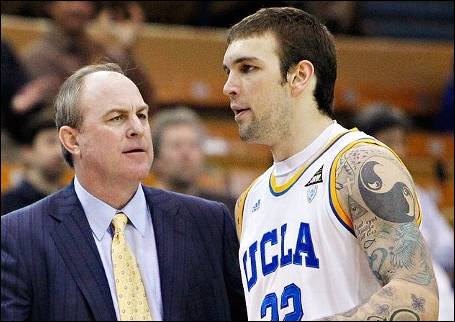 |
|
—AP
UCLA coach Ben Howland
and Reeves Nelson are pictured during a UCLA basketball game.
|
After leaving
UCLA, Nelson played for a pro team in Lithuania for five weeks, returning to
await the results of the 2012 NBA draft. When no team selected him, he tried
unsuccessfully to catch on with the Los Angeles Lakers, then played in the NBA
Development League.
The website
LatinBasket reported that he played this year for a team in Nogales, Mexico.
The story
claimed Nelson had been involved in numerous incidents in which teammates were
physically attacked or otherwise demeaned. He supposedly deliberately injured
teammates during practice; urinated on a fellow player’s bed; pulled on a
player’s arm, reinjuring the man’s surgically repaired shoulder; knocked
another teammate to the ground from behind, injuring his back; and injured
another player by elbowing him in the ribs, all of which he denied.
Nelson further
denied Dohrmann’s assertion that he had admitted those allegations and
apologized for them when he said:
“On all that
stuff, I have no trouble admitting that I lost control of my emotions
sometimes. I take responsibility for my actions. I’m really just trying to
learn from the mistakes I made on all levels.”
Dohrmann and his
editor both filed declarations insisting that the story had been carefully and
accurately sourced.
Los Angeles
Superior Court Judge Lee Edmon, writing for the Court of Appeal while sitting
on assignment, agreed with the trial judge that the plaintiff was a limited
purpose public figure who must prove actual malice in order to prevail. But
Edmon also concluded that Nelson had a prima facie case because if he can prove
that he never admitted to or apologized for the alleged misconduct, he will
have established falsity and actual malice.
She cited Masson
v. New Yorker Magazine (1991) 501 U.S. 496, in which the high court held that a
psychoanalyst who had been interviewed by a reporter regarding his relationship
with the Sigmund Freud archives had established a prima facie case of
defamation, based on evidence that his remarks had been taken out of context
and quotation marks used around comments that he had not made.
Edmon wrote:
“Crediting (as
we must for anti-SLAPP purposes) Nelson’s account of the interview, we conclude
that Dohrmann’s statement that Nelson confirmed some of the incidents described
by the article and expressed regret would support a finding of actual malice.
As in Masson, the alleged falsity is not the words spoken by Nelson, but the
context in which the words are placed. As reported by Dohrmann, Nelson appears
to be admitting and apologizing for each of the incidents described in the
article. But Nelson says these incidents never happened and more significantly
for our analysis that Dohrmann never asked him about them. Although Nelson concedes
he made the quoted statement, he says it was in response to Dohrmann’s inquiry
as to how he felt about his suspension and expulsion from the team, not an
inquiry about the particular incidents described in the article. This
difference is material because it significantly changes the meaning of Nelson’s
admission and apology. As such, it would support a finding of actual malice.”
The case is Nelson
v. Time, Inc., B245412.
